Description
Trio in A Minor Op.441-Audio Samples: 1st Movt, 2nd Movt & 3rd Movt.
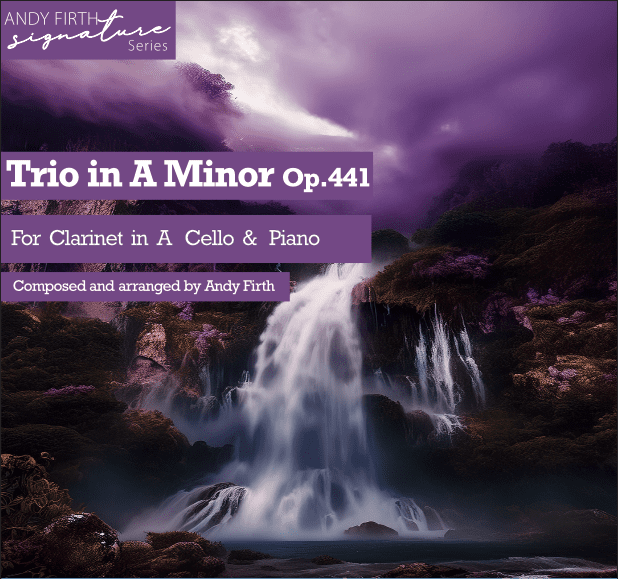
Trio in A Minor Op.441
Level: Advanced
Trio in A Minor Op.441
The first sketches of this work date from 2009 and mark my initial exploration of chamber writing for clarinet, cello, and piano. At the time, I was studying orchestration and composition with my mentor and dear friend, the great Australian maestro and composer Tommy Tycho. He encouraged me to expand beyond jazz-styled instrumentation and explore the expressive possibilities of mixed chamber ensembles.
Although I had previously composed for clarinet in various combinations, this was my first work to include cello and piano, and my first sustained engagement with string and wind textures outside a jazz-influenced context. At Tommy’s suggestion, I studied the chamber works of Ravel, Arensky, Mozart, Beethoven, and Brahms, gaining insight into the color, balance, and emotional range these instruments can create together.
In 2008, Tommy suffered a serious stroke and our formal lessons came to an end, but the musical journey he set in motion continued. In 2010, I completed an early version of the work and played a demo recording for him in his nursing hospital room. When it finished, he smiled and said, “Andy sweetheart, it is a beautiful work and it deserves to be played and celebrated.”
I have revisited the piece many times over the years, refining and reconsidering its material, yet I consistently return to the version Tommy heard that day. The only significant revision is a slight shortening of the second movement, achieved by removing a passage that distracted from its intended mood and sentiment.
About the Movements
The First Movement
Opens with the cello presenting the main theme in a wandering, tentative manner, as though searching for identity and purpose. The clarinet and piano soon enter in a similar spirit, weaving and expanding upon fragments of the theme in an effort to support and strengthen the cello. Gradually, the three instruments converge around a shared idea, culminating in a bold statement of the main theme by the clarinet.
The cello then assumes the lead, accompanied by a buoyant piano and clarinet texture that slowly subsides. A sudden, rapid piano glissando ushers in a livelier section, with the clarinet and cello alluding to the spirit of the main theme. This develops into a moderate waltz-like passage, featuring a derivative of the theme in the cello. Energy and excitement continue to build toward a climax, giving way to an extended duet between the clarinet and cello. The piano reenters, and all three instruments unite to drive the movement toward a final, furious, and powerful conclusion.
The Second Movement
Is scored in the style of a contemporary love ballad, subtly stylized to align with the work’s broader 19th-century Romantic aesthetic. The clarinet introduces a sweet, languid theme, tinged with gentle melancholy, supported by a sympathetic cello and piano accompaniment. The movement unfolds fluidly, gradually building as the thematic material is passed between the clarinet and cello. It closes as it began, with the clarinet restating the main theme.
The Third Movement
Lunges forth like a tiger leaping from the savanna at unsuspecting prey—furious, powerful, and unstoppable. The first theme is introduced by the clarinet and then echoed by the cello. This gives way to a sweeter, more fugal section in which the main theme is passed between all three instruments, gradually shaped and transformed.
A slow, dramatic, and solemn passage follows, leading into a furious ostinato in the piano, against which the clarinet sounds the main theme in heavy syncopation. The three instruments dive and weave through passages derived from the theme before finally uniting, culminating in a brief cello cadenza.
The clarinet and cello then engage in an extended, fiery duet, dancing around one another as each strives to lead the pack. Suddenly, the piano rejoins them, and all three instruments unite once more, driving toward a final, serious, and solemn restatement of the first movement’s main theme—serving as a moral to the story and bringing the work to its close.
This product comes with clarinet in Bb, cello and piano parts as well as mp3 performance and backing tracks.
Duration: circa 15 mins